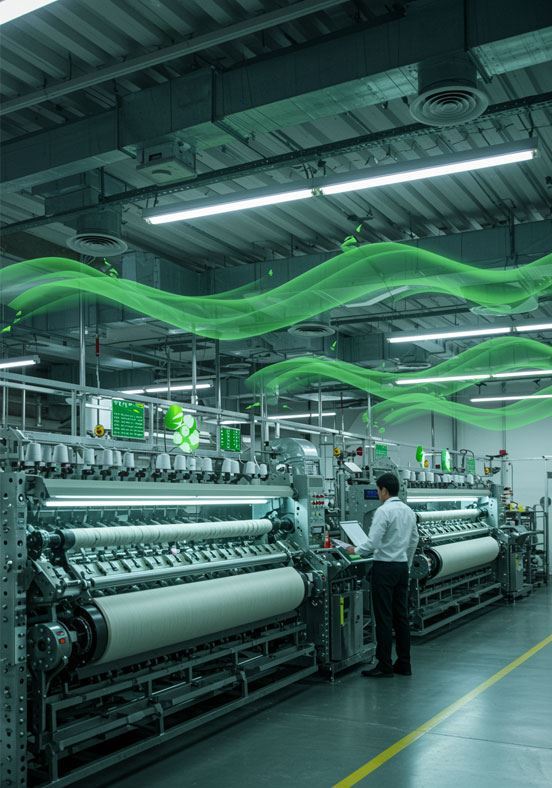

Textile production sits at the intersection of mechanical precision and material sensitivity. Every fiber, whether cotton, wool, polyester, or a blended composition, responds to its surrounding environment in measurable ways. When the air inside a mill drifts even slightly outside the optimal range, the consequences appear almost immediately on the production line: weaker yarns, irregular tension, static electricity, and rising defect rates. This is why modern textile facilities treat climate control not as a comfort feature but as a core production parameter.
The relationship between air quality and textile output has been studied extensively for over a century, and the conclusions remain consistent. Spinning, weaving, knitting, and finishing processes each require their own specific temperature and humidity windows. A weaving hall running at 22°C with 70% relative humidity behaves entirely differently from one operating at 28°C with 50% humidity. Even small deviations translate into productivity losses that accumulate across shifts, weeks, and seasons.
For mill owners and production managers, climate control is also a strategic investment. It reduces raw material waste, extends the lifespan of expensive machinery, and protects the consistency of finished goods. In competitive export markets where buyers expect tight quality tolerances, the ability to maintain stable atmospheric conditions becomes a genuine commercial advantage rather than a background utility.
How Humidity Directly Impacts Yarn and Fabric Quality
Humidity is arguably the single most influential environmental factor in any textile operation. Fibers are hygroscopic, meaning they absorb and release moisture from the surrounding air. Cotton, for example, can change weight by several percent depending on the ambient humidity, and that shift directly affects how it behaves on spinning frames and looms.
When the air is too dry, yarns become brittle and prone to breakage. Static electricity builds up rapidly, causing fibers to repel each other, cling to machine parts, and create flyaway lint that contaminates the production area. Operators end up spending more time on repairs and cleaning than on actual production. On the other hand, excessive humidity creates its own set of problems. Fibers become sticky, build up on rollers, and increase the friction inside machinery, which leads to uneven yarn diameter and surface imperfections in the final fabric.
Maintaining the correct moisture regain is also a financial issue. Yarn is often sold by weight, and proper conditioning ensures that the product leaves the facility with the agreed moisture content. Mills operating without precise humidity control either lose revenue by shipping under-conditioned goods or risk customer complaints when fabrics behave unpredictably after delivery.
The most successful textile operations treat humidity as a continuously managed variable rather than a static setting. Automated humidification and dehumidification systems work in tandem with sensors distributed throughout the production hall, adjusting in real time to seasonal changes, machine heat output, and even shift patterns. This level of responsiveness is what separates a modern, quality-focused mill from one still relying on outdated manual methods.
Preventing Machine Downtime with Consistent Temperatures
Textile machinery is built to operate within specific thermal ranges, and prolonged exposure to fluctuating temperatures shortens the working life of nearly every mechanical and electronic component. Bearings expand and contract, lubricants change viscosity, and control electronics become unreliable when the surrounding air swings between extremes throughout the day.
Heat buildup is a particular concern in spinning and weaving departments where motors, drive systems, and friction points generate significant thermal load. Without adequate cooling and air circulation, ambient temperatures can climb well beyond the design limits of the equipment. The result is more frequent breakdowns, longer maintenance intervals, and the kind of unplanned downtime that disrupts delivery schedules and erodes profit margins.
Consistent temperature management also protects the calibration of precision machinery. Modern looms and knitting machines rely on tight mechanical tolerances, and thermal expansion can throw off settings that took hours to fine-tune. A stable climate keeps these adjustments valid for longer, reducing the need for repeated technical intervention and allowing operators to focus on output rather than troubleshooting.
Energy-Saving Climate Solutions for Textile Factories
Energy consumption is one of the largest operational costs in any textile facility, and a significant portion of that cost goes directly into heating, cooling, ventilation, and humidification. The good news is that modern climate control technology has advanced considerably, offering mill operators practical ways to reduce energy use without compromising production conditions.
A well-designed system focuses on efficiency at every stage, from how outside air is brought in to how conditioned air is distributed across the production floor. Below are some of the most effective approaches currently used in textile factories around the world:
- Heat recovery ventilation: Captures thermal energy from outgoing air and transfers it to incoming fresh air, dramatically reducing the load on heating and cooling equipment.
- Variable speed drives on fans and pumps: Adjust airflow and water circulation based on actual demand rather than running at full capacity around the clock.
- Adiabatic humidification: Uses the natural cooling effect of evaporation to humidify and cool air simultaneously, lowering reliance on mechanical refrigeration.
- Zoned climate control: Treats different departments according to their specific requirements instead of conditioning the entire facility to a single setpoint.
- Smart sensor networks: Continuously monitor temperature, humidity, and air quality, allowing the system to respond precisely to changing conditions and avoid wasted energy.
- High-efficiency filtration: Reduces resistance in the airflow path, meaning fans consume less electricity while still maintaining clean production environments.
Adopting even a few of these solutions can lead to meaningful reductions in monthly utility bills. More importantly, the savings tend to compound over time as the equipment runs under less stress and requires fewer repairs. For factories looking to align with sustainability goals or comply with environmental regulations, these technologies also help reduce the overall carbon footprint of production.
Improving Worker Comfort and Factory Safety
Behind every successful textile operation are the people who run the machines, monitor the processes, and maintain the equipment. Their working environment has a direct effect on productivity, accuracy, and long-term retention. A poorly ventilated, overheated, or dust-laden production hall takes a measurable toll on workforce performance, and that toll eventually shows up in the quality of the finished goods.
Proper climate control creates conditions where workers can concentrate, move efficiently, and stay alert throughout their shifts. Temperature stability prevents the kind of fatigue that builds up during long days in hot environments, while controlled humidity reduces respiratory irritation caused by airborne fiber dust. Operators in well-conditioned facilities consistently report fewer headaches, less eye strain, and lower rates of absenteeism.
Safety is another dimension that often gets overlooked. Textile mills handle large volumes of fine fiber particles, and when humidity drops too low, the combination of dust and static electricity creates a serious fire risk. Maintaining adequate moisture in the air is one of the simplest and most effective ways to mitigate this hazard. Clean, well-circulated air also helps comply with occupational health standards that have become stricter across most regulatory environments.
There is also a recruitment and retention angle worth considering. Skilled textile workers are in short supply in many regions, and factories offering a comfortable, professionally managed work environment are far more likely to attract and keep experienced operators. In an industry where labor stability translates directly into production stability, this is not a minor consideration.
Below are some of the key health and safety benefits that come from a properly engineered climate control system:
- Reduced respiratory issues: Controlled humidity and proper filtration minimize the amount of fiber dust workers inhale during their shifts.
- Lower fire and explosion risk: Adequate moisture levels prevent the accumulation of static charges in dust-heavy environments.
- Improved cognitive performance: Stable temperatures help operators stay focused, reducing errors and workplace accidents.
- Better thermal comfort: Balanced conditions across the production floor eliminate the hot and cold zones that strain the body over long shifts.
- Compliance with occupational standards: Modern systems make it easier to meet local and international regulations on workplace air quality.
- Higher employee satisfaction: A comfortable environment supports better morale and reduces turnover among trained staff.
Optimize Your Production Environment with Tufekci Machine
Building a textile facility that performs consistently under all conditions requires more than just installing equipment. It requires a partner who understands the specific demands of yarn, fabric, and finishing processes, and who can design climate solutions tailored to the realities of each production hall. This is the area where Tufekci Machine has built its reputation over many years of working alongside textile manufacturers.
Every facility is different. Layout, machinery type, regional climate, and product mix all influence what the ideal solution looks like. Rather than offering a one-size-fits-all package, the engineering approach focuses on analyzing actual production conditions, identifying the points where climate variability is causing losses, and designing a system that addresses those issues directly. The result is a tailored installation that improves quality, reduces energy consumption, and supports long-term operational stability.
For mill owners ready to take a closer look at how climate control can transform their production, exploring the full range of textile climate solutions is a good starting point. The team is also available for technical consultations and on-site assessments through the main company page at tufekci.com.tr, where you can learn more about ongoing projects, completed installations, and the engineering expertise behind each system.
Investing in the right climate control infrastructure is one of the most reliable ways to protect product quality, reduce operating costs, and create a working environment that supports both machines and people. With the right partner and the right system, a textile facility can operate at its full potential year after year, regardless of what is happening outside its walls.